
Most of the work behind a new central air system happens before and after the day the equipment arrives. The crew may only spend one or two days on site, but the full process in Montgomery County usually runs two to four weeks once the load calculation, contract terms, municipal permit, equipment order, startup testing and final inspection are counted. Homeowners who understand that sequence tend to ask better questions, spot shortcuts early, and end up with paperwork that protects them for the life of the system.
Timing plays a bigger role than most people expect. Fall is the shoulder season for cooling work in southeastern Pennsylvania, when installers have open calendars, municipal permit offices are not backed up with spring applications, and there is no pressure to rush a system in before a heat wave. A furnace that is nearing replacement can also be matched with the new coil and condenser in the same project, which avoids pairing new cooling equipment with an aging blower.
Homeowners planning central air condintioning installation in Montgomery County can start with a free in-home estimate from Energy-Star Services, whose office sits right on County Line Road in Huntingdon Valley. Estimates are often available the same day, and installation can follow as soon as the next day when equipment is in stock, with every system backed by industry-leading warranties. Their team handles the connected pieces that usually require separate trades, including the furnace or air handler, ductwork concerns, electrical circuits and indoor air quality add-ons, so the whole project stays with one accountable crew. Scheduling that visit during the fall slowdown is the easiest way to lock in a proper load assessment and an install date well before the first hot week of summer.
The Estimate Visit and the Load Calculation
A proper estimate starts with measuring the house rather than reading the label on the old unit. Pennsylvania enforces its Uniform Construction Code, which is based on the International Residential Code, and that code expects cooling equipment to be sized using ACCA Manual J for loads and Manual S for equipment selection. Montgomery County sits in climate zone 4A, where summer design conditions around 90 degrees come with heavy humidity. That humidity matters. An oversized unit cools the air quickly, shuts off, and leaves moisture behind, which is why many homes with too much tonnage still feel clammy.
A thorough technician will note window area and orientation, attic insulation depth, duct sizes, and how the existing return air is set up. Many colonials and split levels in Abington, Lower Merion and Horsham were built with small or single returns, and adding one is often the most effective improvement in the entire project.
The Proposal and What Pennsylvania Requires in It
Pennsylvania’s Home Improvement Consumer Protection Act shapes this stage. Contractors doing residential work must register with the state Attorney General and display that registration number on their contracts. For projects over $500, the agreement must be in writing, homeowners have three business days to cancel, and deposits are generally limited to one third of the contract price plus the cost of special order materials.
Beyond the legal requirements, a clear proposal lists model numbers for both the outdoor condenser and indoor coil, their matched efficiency rating, whether the refrigerant line set will be replaced or reused, electrical work, condensate details, and who is responsible for permit fees.
Permits and the Equipment Order
Montgomery County has dozens of townships and boroughs, and each enforces the building code on its own. Some use their own inspectors, while others rely on third-party inspection agencies. A central air replacement typically requires a mechanical permit, and many municipalities also require a separate electrical permit for the new circuit and disconnect. Some townships also enforce setback rules for where outdoor units can sit near property lines, which is especially relevant for twins and townhomes.
The equipment itself has changed recently. New residential split systems now use A2L refrigerants such as R-454B or R-32 instead of R-410A, and they must meet the federal minimum of 13.4 SEER2 for northern states. Many new indoor coils also come with a refrigerant leak sensor that connects to the furnace control board, adding a wiring step that older installation crews may not be familiar with.
Installation Day
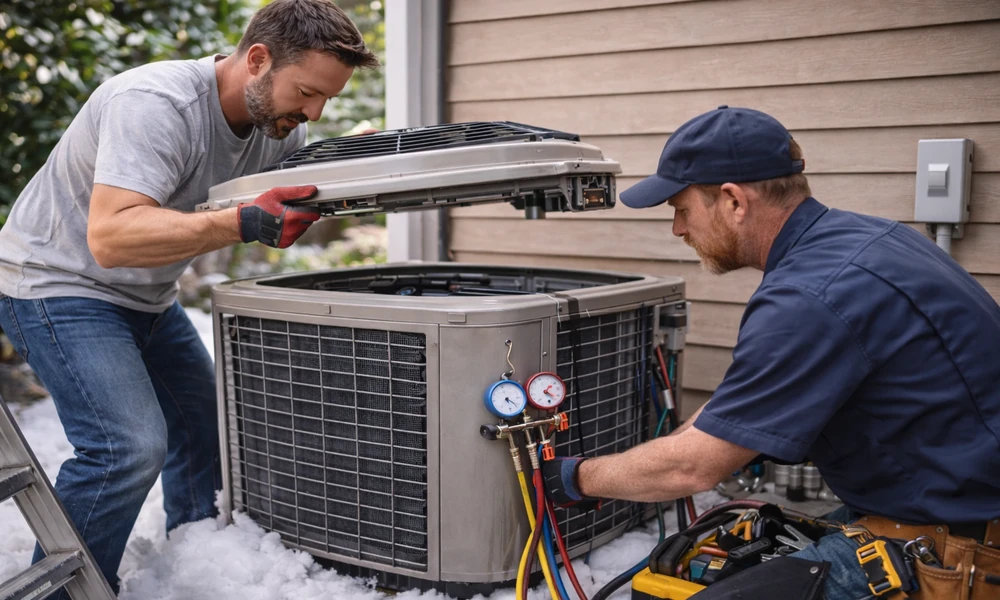
A standard installation follows a predictable order. The old refrigerant is recovered by an EPA certified technician, the old condenser and coil are removed, and a new level pad is set, raised above the soil to keep debris and snow away from the base. The new coil is mounted on the furnace or air handler, the line set is brazed with nitrogen flowing through the pipes to prevent internal scale, and the outdoor electrical disconnect is installed within sight of the unit. Condensate lines get a trap. Attic air handlers also require a secondary drain pan or a float switch that shuts the system down if water begins to back up.
Startup and Commissioning
This is the step most often rushed. The system should be pressure tested with nitrogen, evacuated to roughly 500 microns, and allowed to sit to confirm that the vacuum holds before any refrigerant is released. Once it is running, the refrigerant charge is verified by measuring superheat or subcooling against the manufacturer’s specifications, and static pressure is checked to make sure the ductwork is not restricting airflow. A temperature difference of about 15 to 20 degrees between return and supply air on a warm day is a good sign that everything is working properly.
| Stage | Who is involved | Typical time frame | What the homeowner should keep |
|---|---|---|---|
| Estimate | Comfort advisor or lead technician | One visit, about 1 to 2 hours | Load calculation summary |
| Proposal | Contractor and homeowner | 1 to 3 days | Signed contract showing state registration number |
| Permit | Contractor and municipality | Several days to 2 weeks | Permit number and approved application |
| Equipment order | Contractor and distributor | Same day to 2 weeks | Model and serial numbers |
| Installation | Install crew and electrician | 1 to 2 days | Line set and electrical notes |
| Commissioning | Lead technician | Final hours of install | Startup readings sheet |
| Final inspection | Township or third-party inspector | Within a few weeks | Signed inspection approval |
Final Inspection and the Warranty Clock
The inspector checks the disconnect, circuit size, clearances, condensate handling and permit documents. Once the project passes, one step remains that often gets missed. Most manufacturers offer extended parts coverage only if the equipment is registered online within about 60 days of installation. Keeping the commissioning sheet, permit approval and registration confirmation together gives any future technician, buyer or home inspector a complete history of how the system was installed.